In today’s world, conflicts and wars are often explained in terms of “national security,” “war against terror,” or “territorial defense.” But over a century ago, Russian revolutionary Vladimir Lenin offered a different way to understand war—one that focuses less on justification and more on who benefits, and why the war is being fought in the first place.
Two very different kinds of war
This isn’t about who fires the first shot. It’s about class interests and class struggle in the era of monopoly capitalism and proletarian revolution. It’sabout the struggle of the proletariat against the bourgeoisie.
Lenin’s distinction between imperialist war and revolutionary war remains a powerful tool for making sense of current conflicts. At the heart of Lenin’s framework is a simple but sharp contrast:
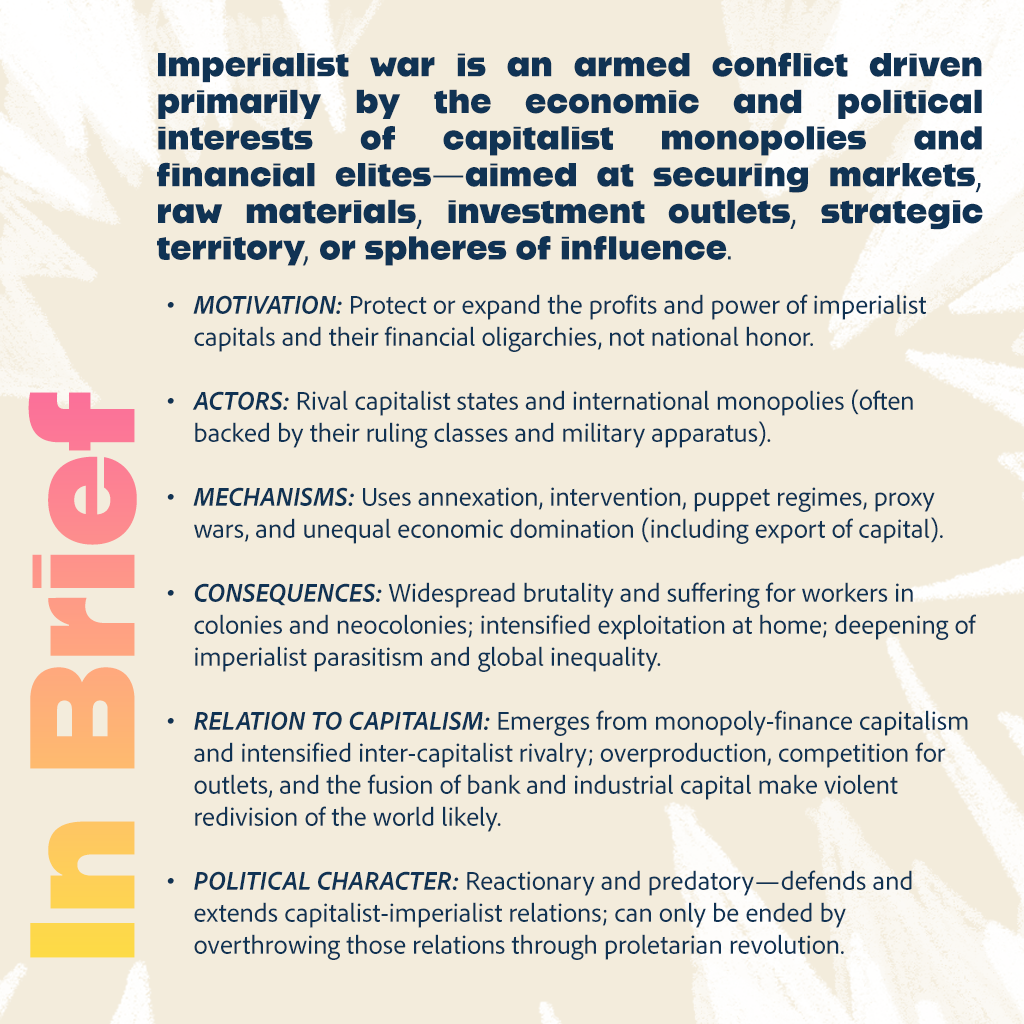
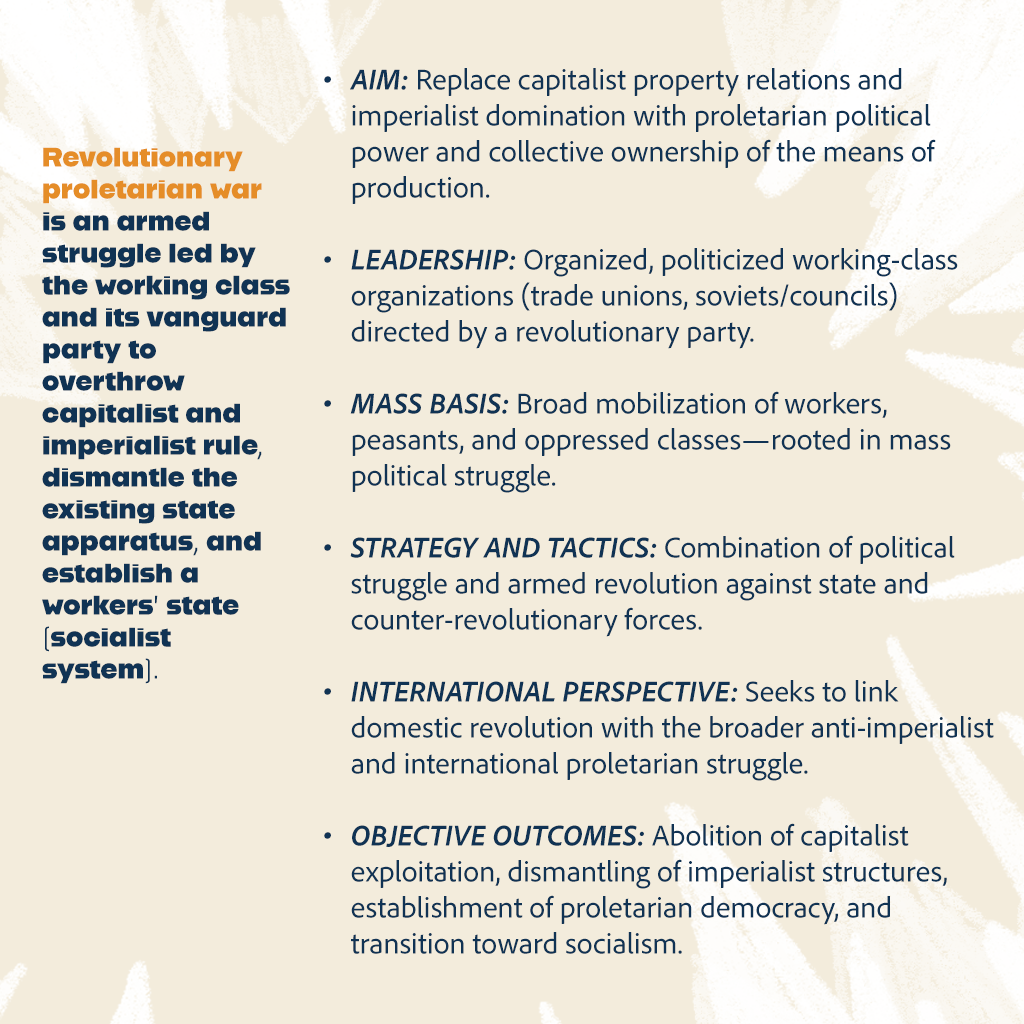
Imperialist wars are fought by powerful states like the United States to expand or protect economic and political dominance, while revolutionary wars are fought by oppressed classes—particularly the proletariat or working class—or nations fighting to overthrow that dominance, assert national sovereignty, and build a new social order, specifically socialism.
Imperialism means war
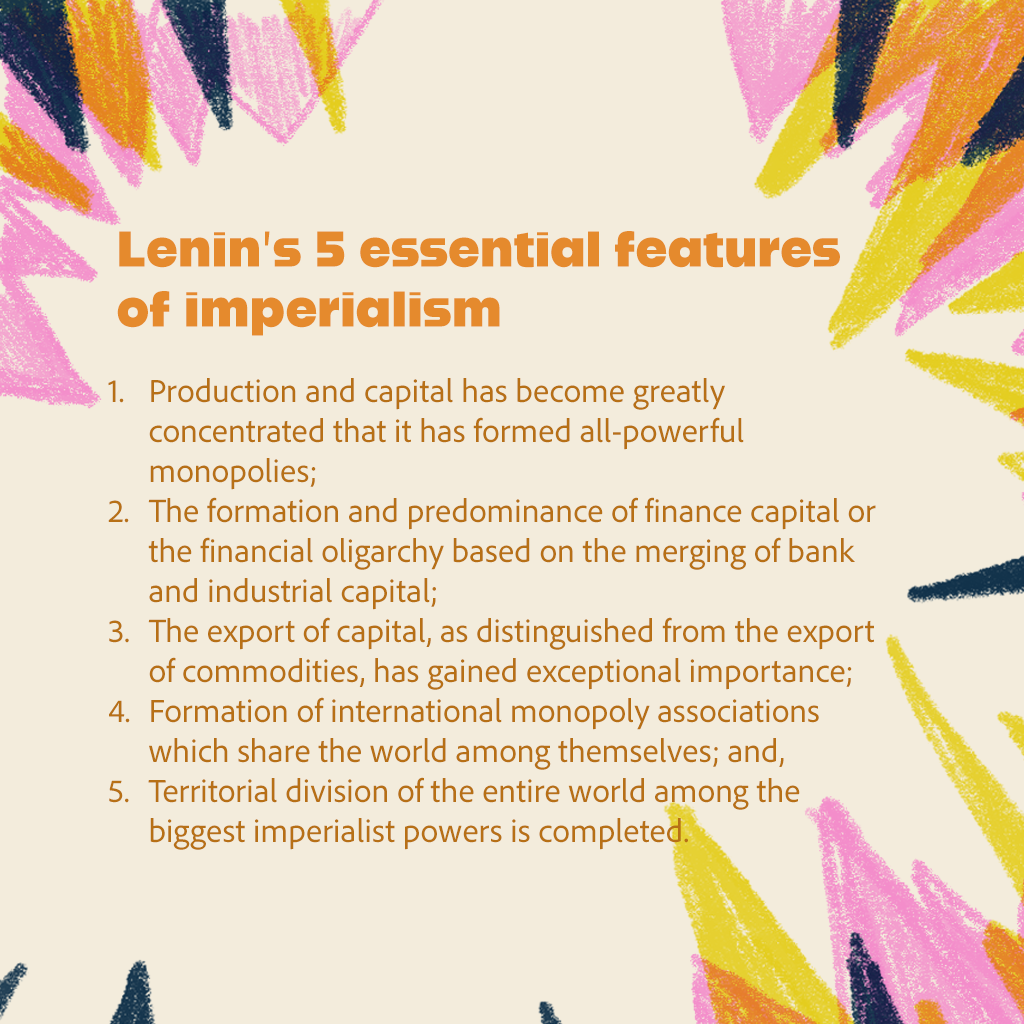
Lenin describes imperialism—or late-stage capitalism—as the concentration and centralization of capital into monopolies and finance capital, the fusion of banking and industrial interests, and the export of capital (not merely goods) to colonies and neocolonies. These developments produce global domination by a small number of powerful monopolies and financial groups.
Rather than eliminating competition, monopoly capitalism intensifies it. Rivalry among capitalists and between imperialist states becomes fiercer, pushing a continual drive for territorial and economic expansion. To secure higher profits and strategic advantage, capital seeks ever more raw materials, investment outlets, markets, and spheres of influence while enlarging the reserve army of labor to suppress wages. This heightened struggle produces recurring crises of overproduction and frequently leads to armed conflict. In Lenin’s analysis, wars of annexation and intervention thus become inevitable under imperialism.
In the December 26, 2025 the CPP’s anniversary statement stated that the “intensifying political, financial, economic, trade, and military conflicts between the biggest imperialist countries are the principal contradiction, particularly in the face of the US imperialism’s relentless imposition of its hegemony over the entire world.”
Imperialist war follows from the economic and political logic of monopoly-finance capitalism for two connected reasons:
- Fierce rivalry over the redivision of the world—markets, colonies, raw materials, investment outlets, and spheres of influence—when existing partitions and profitable outlets prove insufficient.
- The dominance of finance capital—the merger of bank and industrial capital—combined with the export of capital and the emergence of international monopolies that partition the globe; in these conditions, violent redivision becomes a practical instrument for securing profits and strategic advantage.
Not to be overlooked is the fact that defense industries, arms sales, and security contracts all benefit from prolonged tension. War—or the threat of it—creates economic opportunities for powerful sectors.
Such wars are predatory. They are fought not chiefly for abstract notions of national honor but to defend or expand the economic interests of imperialist capitals and their financial oligarchies. They deepen the parasitic and decaying features of imperialist societies and can be ended only by proletarian revolution and the overthrow of capitalist-imperialist relations.
Eve of social revolution of the proletariat
The crisis-prone and unstable imperialism is terminal and that makes proletarian revolution historically imminent.
Imperialism intensifies exploitation, deepens inequality, and forces rivalry among imperial powers (wars, colonial oppression). That heightens workers’ misery and radicalizes them. The result, Lenin predicts, is conditions favorable for proletarian revolution—the overthrow of capitalist rule and establishment of socialism.
In October 2023, the CPP’s keynote paper to the NDFP-sponsored International Theoretical Conference on Imperialist Wars emphasized that the rising inter-imperialist tensions that are escalating into open conflict and war unleash widespread brutality and suffering for workers and other toiling people, deepen national oppression in colonies and semicolonies, and further intensify exploitation of workers inside capitalist states.
The working-class response, it said, should be to oppose and prevent inter-imperialist wars, demand their immediate cessation when they occur, and use the crisis to advance democratic and socialist aims—mobilizing proletarian and allied progressive forces to protect workers’ interests and push for systemic change.
Also, it believes that these “generate opportunities for communist and workers parties to raise their capability and place themselves in a better position to take advantage of a possible explosion of a revolutionary situation by leading the broad masses of workers, peasants and other exploited and oppressed classes onto the path of revolutionary class struggles in their countries.”
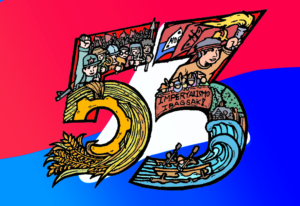
In March 2026, the CPP’s statement on the 57th anniversary of the New People’s Army called on the Filipino people to wage people’s war to fight imperialist war and crisis.
There is a real risk today that existing inter-imperialist conflicts will intensify and new ones will erupt elsewhere. Stopping these wars ultimately depends on workers and ordinary people carrying out revolutionary, class-based struggles against their ruling class governments, in imperialist countries, or in states being exploited as pawns, staging areas, or military footholds in an imperialist war.
Understanding war isn’t just about maps and missiles—it’s about power and purpose. Behind every conflict lies a struggle over who controls resources, wealth, and the future itself. Rightfully, it should belong to the hands of those who truly create the material wealth of a society—the proletariat. ### (Iliya Makalipay)