Back in 2023, in its 55th anniversary statement, the Communist Party of the Philippines launched an organization-wide rectification movement aimed at addressing longstanding internal problems of the revolutionary movement in the Philippines. In the spirit of criticism and self-criticism, the Party aimed to revitalize its forces in the face of clear setbacks over the past few years. The rectification movement set out to resolve issues across all aspects of the revolution, from the work carried out in urban areas to the armed struggle in the country side.
Two years later, in the 57th anniversary statement of the CPP, the Central Committee recognized that the movement had achieved moderate gains in its implementation of the rectification movement. However, there was still some way to go, with the statement highlighting some areas had not yet been fully addressed or resolved.
When I first heard that the CPP was launching a third rectification movement, it seemed, of course, quite daunting. As a young revolutionary — much, much younger than the CPP and the national democratic movement as a whole — all I had heard about “rectification” at that point were the stories from the First Great Rectification Movement of the late 60’s and the Second Great Rectification Movement of the 90’s. Both were made out to be rather turbulent, confusing times. So what’s going on in this Third Rectification Movement? What’s it got to do with what we do in our organizations under the NDFP?
Third time around
If you read the CPP statement that officially launched the current kilwas, while it notes that this is the third time this is happening, it avoids calling this one “great”, unlike the First and Second Great Rectification Movements. Why is that? Based on the 55th anniversary statement, it has something to do with the fact that the Party is still very much solid as a whole, with its members all in general agreement as to the economic and political analysis of Philippine society, the strategy and tactics to be used, and many other fundamental points. Very much unlike the first two recti movements, which were marked by clear ideological disagreements internally.
So far, so good, then. So what’s there to rectify? For starters, it’s clear that, over the past few years, instead of advancing, the movement has retreated. In one of its statements, the CPP noted how, after a period of general stagnation since the mid-2000s, the movement experienced major setbacks starting 2017–2018.
For an outsider, it might be easy to chalk things up to the counterrevolutionary oplans of the likes of the tyrant Rodrigo Duterte. The Party, however, takes it a step further—while recognizing that the reactionary regime is indeed doing all it can to crush the people’s revolution, we need to look inward at our internal problems and see what we need to overcome, to place ourselves in a position of strength against our enemies.
So the challenge now is to learn from our mistakes and do better. With the third rectification movement, the CPP and all the organizations it leads—from the NPA to the organizations under the NDFP—is doing exactly that.
Empiricism, the main error
The CPP identified empiricism, a form of subjectivism, as the main internal error right now. Being subjective, just like how the term is usually used, means being one-sided or just looking at things from a single point of view. Empiricism is a particular way of being subjective; rooted in the word “empirical”, or working with what you can directly see, hear, observe. Empiricism just means understanding things based only on what you see in front of you. What the Party has set out to correct is the tendency not to look back at the wealth of revolutionary theory and see how this can be creatively applied in the various tasks we take on as revolutionaries.
What might this look like in practice? Conducting political work mechanically, using the same approach on repeat without bothering to take a step back and sum up experiences so that we might improve. Getting caught up or stuck in dealing with what’s directly in front of you—the technicalities of reactionary legislative frameworks, or a defensive military situation—that you are unable to take a step back and see the bigger picture on what work can be and should be done to advance the revolution tangibly. Becoming content with shallow analyses and half-baked investigations into the concrete conditions of the areas and sectors we operate in.
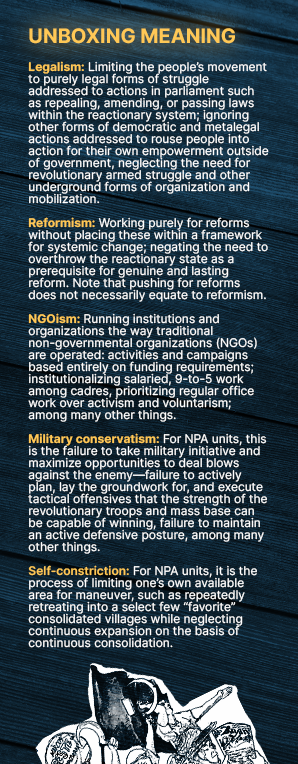
As you might expect, it is this empiricist mindset that has led to several of the other isms criticized by the Party: legalism, reformism, NGOism among those working in organizations and institutions in the city, military conservatism and self-constriction in many units of the NPA. These manifestations of empiricism have real implications—increasing number of defensive battles among NPA units, decreasing number of tactical offensives, lower recruitment into our revolutionary organizations, among many others.
As the Party has self-criticized to rectify its errors,
we are all challenged to examine ourselves individually and collectively, and see what we can do to regain lost ground and
advance the Philippine revolution tangibly.
Back to basics
So what does the CPP task its membership to do to address the shortcomings of the past years? This third kilwas is characterized as a “study movement” — a movement to brush up on revolutionary theory, and build ideological understanding and strength to face and overcome the challenges of today. Among other things, Party members have been tasked to visit and revisit classics of Marxist-Leninist-Maoist theory, conduct educational discussions and see how these impact our work in strengthening the organization and the movement as a whole.
For NDFP-affiliated organizations, we are also invited to take our educational work seriously and to the next level. In addition to courses like Araling Aktibista, we can expand our curricula to include discussions on the whole 12-point program of the NDFP, as well as courses such as Eskum Digmang Bayan. This way, we can also help build the foundations of revolutionary theory and practice among our members, and contribute to addressing the problematic isms affecting the movement today.
Being part of the third rectification movement is daunting, but as they say, internal ang mapagpasya. As members of our organizations under the leadership of the CPP, we are in on this. As the Party has self-criticized to rectify its errors, we are all challenged to examine ourselves individually and collectively, and see what we can do to regain lost ground and advance the Philippine revolution tangibly. ### (Bernadette Rojo)