We witnessed how, on September 21, the police lobbed tear gas canisters on the protesters, including by-passers and on-lookers, followed by endless beatings, manhandling, arrests and incarceration. At the day’s end, scores were injured, 248 arrested and jailed, and two were killed. Police subpoenas and threats of arrests continue to haunt student leaders who joined the protest and the subsequent student walk-out in many campuses and universities.
Police brutality during the protest in Mendiola had some people asking: is fascism during the Marcos dictatorship back?
What even Is fascism?
Georgi Dimitrov, a Bulgarian communist leader and theorist, gave a widely cited definition of fascism in his speech at the 7th World Congress of the Communist International in 1935: “Fascism is the open terrorist dictatorship of the most reactionary, most chauvinistic, and most imperialist elements of finance capital.”
In simpler terms, fascism is when the richest and most powerful parts of big business (finance capital) use violence and terror openly, through the state, to protect their power. It’s not just a regular dictatorship—it is extremely oppressive, nationalistic, and tied closely to big capitalist interests against the working class, unions and communists. Big business relies heavily on military and police force to stay in power, divides and controls the people and destroys their democratic rights and freedoms.
Repressive instruments of the state—the armed forces, media, the courts and legislative bodies—are overtly used to preserve a system ruled by a few oppressive and exploitative classes. In the Philippines, it’s the bureaucrat capitalists and dynasties in the government and their masters—the landlords, big business, and the imperialists.
Usually led by one “strong” leader (who wants all the power), fascists rely on the use of fear and intimidation to control the everyday life of the people. Freedom of speech is curtailed. A fascist ruler hates criticism and often uses fear to keep people quiet—silencing criticisms, protests, the critical media, and all opposing opinions. But it also uses deceit, peddling disinformation, conditioning the mindset of the people to support the regime, and tagging its critics as “subversives,” “enemies of the state,” and “terrorists” to deny them the legitimacy of their demands and struggles.
A quick look back
Martial law and the Marcos dictatorship is the most familiar and open form of fascism in Philippine history. It was amid a sharp economic crisis, socio-political upheaval, and a nascent national democratic revolution led by the Communist Party of the Philippines that threatened the existence of the US-Marcos Sr regime—representing the fast decaying semicolonial and semifeudal system—that martial law was imposed. The ruling classes could no longer rule in the old way. The late Bishop Antonio Fortich of the Diocese of Bacolod referred to the situation as a “social volcano ready to explode.”
Ferdinand Marcos Sr claimed he declared martial law to stop communism and save the country. But instead, the Filipino people witnessed thousands of activists, opposition leaders, civil libertarians jailed, tortured, or disappeared just for speaking out. Media was shut down or confiscated or controlled by the state. Workers strikes were prohibited, unions were busted. One could be arrested for writing something “against the government.” The military was allover—in the streets, in urban and rural communities where they arrested, threatened, killed people; and, hamletted and bombed peasant and indigenous people’s communities.
People lived in fear. At first. And not for long. Martial law did not hinder the growth and spread of the Communist-led revolutionary movement and the legal democratic movement in urban centers throughout the country. Meanwhile, the Marcos family and their cronies stashed away billions of pesos while the rest of the country suffered in poverty, exploitation, and oppression. Aside from repressive laws, martial law also paved the way for more of the dictator’s decrees and proclamations that favored the interests of the imperialists, big landlords, and bourgeois capitalists.
Fascism didn’t disappear after martial law
Fascism did not fly away with Marcos Sr to Hawaii in 1986. It may not look exactly like 1972: there’s no official declaration of martial law, some trappings of democracy like a new Constitution and regular elections were restored when the dictator was ousted in 1986. There was even an attempt to recover the Marcos ill-gotten wealth. But all these were essentially cosmetic changes. From the so-called restoration of democracy when Cory Aquino took over the reins from Marcos Sr, the succeeding regimes did not institute meaningful reforms nor solve the fundamental problems of society such as bureaucrat capitalism, feudalism, and imperialism—from which fascism rose. Fascism is system-based. And, here are some indications:
1. Impunity continues. The Marcoses were never punished, and neither were their cronies and all those who benefited from the dictatorship. No one was made to account and pay for the crimes committed against the people. They just faded away, albeit temporarily, from the limelight until they crawled back to the center stage, slowly but purposely. Ill-gotten wealth only transferred hands among the bureaucrats, never reaching its true owners—the people who were ravaged by the ruling classes.
The corruption scandals that we witness today? These are familiar cases that have gone from worse to worst because the bureaucrats and their cohorts believe they’re above the law. That’s normal. The people at the top protect each other while the public gets left behind.
Note that the Marcos comeback ironically started during Cory Aquino’s rule—brokered by then Gen. Fidel Ramos (who turned against Marcos Sr at the last hour) and Danding Cojuangco, a known Marcos crony and cousin of Corazon Aquino. And so, the culture of impunity has been paved and cemented from Marcos to Marcos.
2. Marcos-enacted repressive laws and decrees during martial law still exist to this day. Not even the so-called revolutionary government of Cory Aquino repealed these laws such as the Illegal Assembly Act of Batas Pambansa 880 enacted on October 22, 1985 at the height of protests against the Marcos dictatorship. This decree is still used against protesters up to now. Paramilitary groups remain. Marcos Sr’s Civilian Home Defense Forces (CHDF) was only renamed Civilian Armed Force Geographical Unit (CAFGU) during the Cory Aquino regime but still remains as Armed Forces of the Philippines’ nefarious force multiplier in its “counterinsurgency” program.
Duterte’s Anti-Terror Law is not far from Marcos Sr’s Preventive Detention Order/Preventive Detention Arrest (PDO/PDA) in that both allow for arrest and detention of individuals without warrant and on mere suspicion of being subversive, rebel, terrorist or a “threat to national security.” Also, laws, reactionary as they are, are weaponized to discredit the legitimacy of the struggle.
3. The so-called counterinsurgency programs—all patterned after the United States’ “Counterinsugency” (COIN) strategy used in countries where it wages wars, proxy or otherwise—were implemented by the succeeding reactionary regimes after Marcos Sr (who had Oplan Katatagan partnered with a series of military operations such as “nip in the bud,” “Oplan Thunderbolt” against the CPP-NPA).
A fascist regime views war as a way to achieve national goals. It does not recognize the roots of the armed conflict in the country; and turns the table by saying there is poverty because there is armed conflict. It shuns tackling the agenda of the peace negotiations such as genuine agrarian reform and national industrialization that would help propel the country towards progress.
All the succeeding regimes had their own branding to cover up the war they waged against the people:
- Cory Aquino initially had “Oplan Mamamayan” which was later replaced by “Oplan Lambat Bitag” I to IV that extended to Fidel Ramos’ term.
- Joseph Estrada had “Oplan Makabayan”
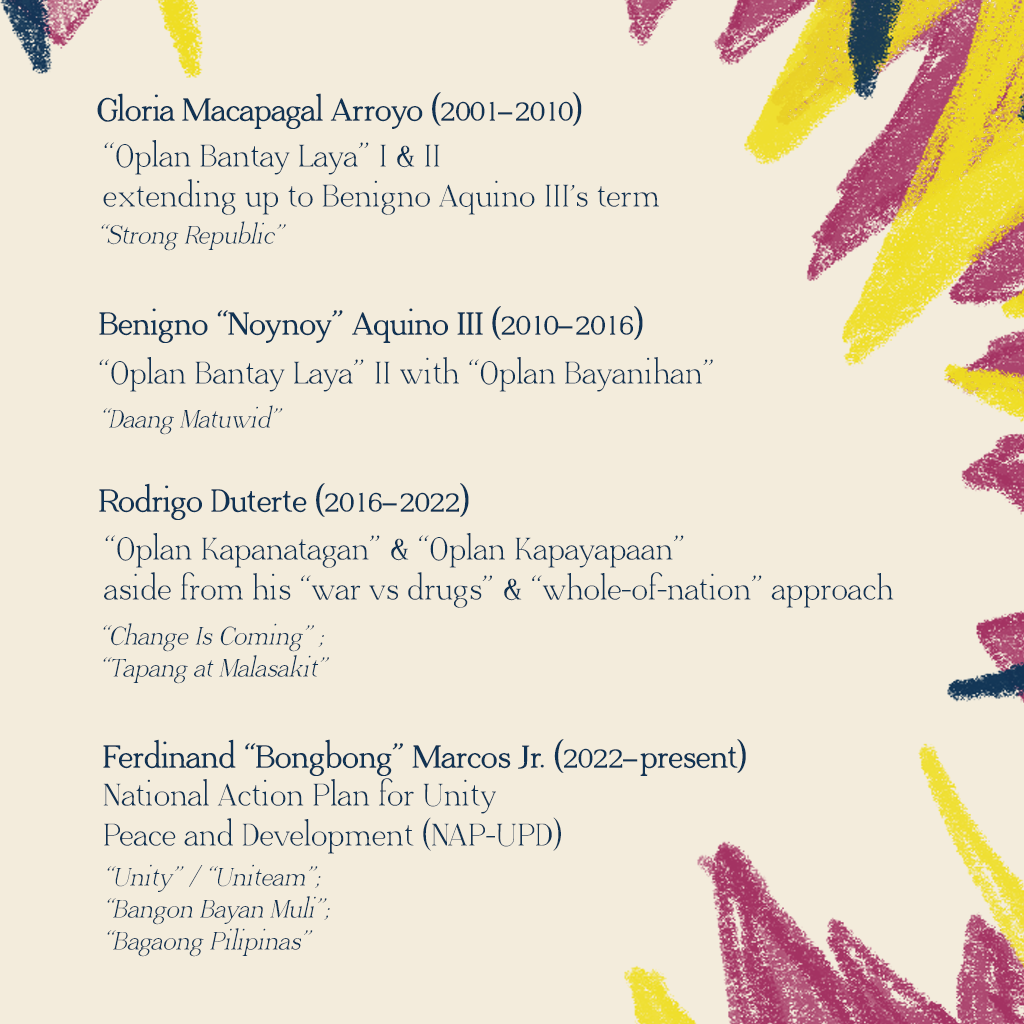
- Gloria Arroyo implemented Oplan Bantay Laya 1 and 2, extending up to Benigno Aquino III’s term
- Benigno Aquino later replaced Oplan Bantay Laya 2 w8ith “Oplan Bayanihan”
- Rodrigo Duterte initially had “Oplan Kapanatagan” and “Oplan Kapayapaan” aside from his “war vs drugs.” It was during Duterte’s term that the “whole-of-nation” approach—also carried out by previous regimes—was institutionalized through the Executive Order 70 issued in December 2018 creating the deplorable NTF-ELCAC.
- Marcos Jr essentially repackaged the previous regimes’ counterinsurgency program into National Action Plan for Unity, Peace and Development (NAP-UPD) which only means the intensification of militarization in the guise of peace and development.
The names and branding change but the targets and victims are the same: Those who fight for their democratic rights and those who work to change the current rotten system into a just and fair society, progressive, and with better living conditions for the masses.
4. As fascism glorifies the role of the military, militarization of civilian bureaucracy has become the norm. First done during martial law, the number of military personnel continued to rise and became more obvious during the Duterte regime as they occupied hundreds of civilian posts from the national to the local levels. All the regimes rehabilitated and recycled human rights violators among the military and police by placing them in the civilian bureaucracy.
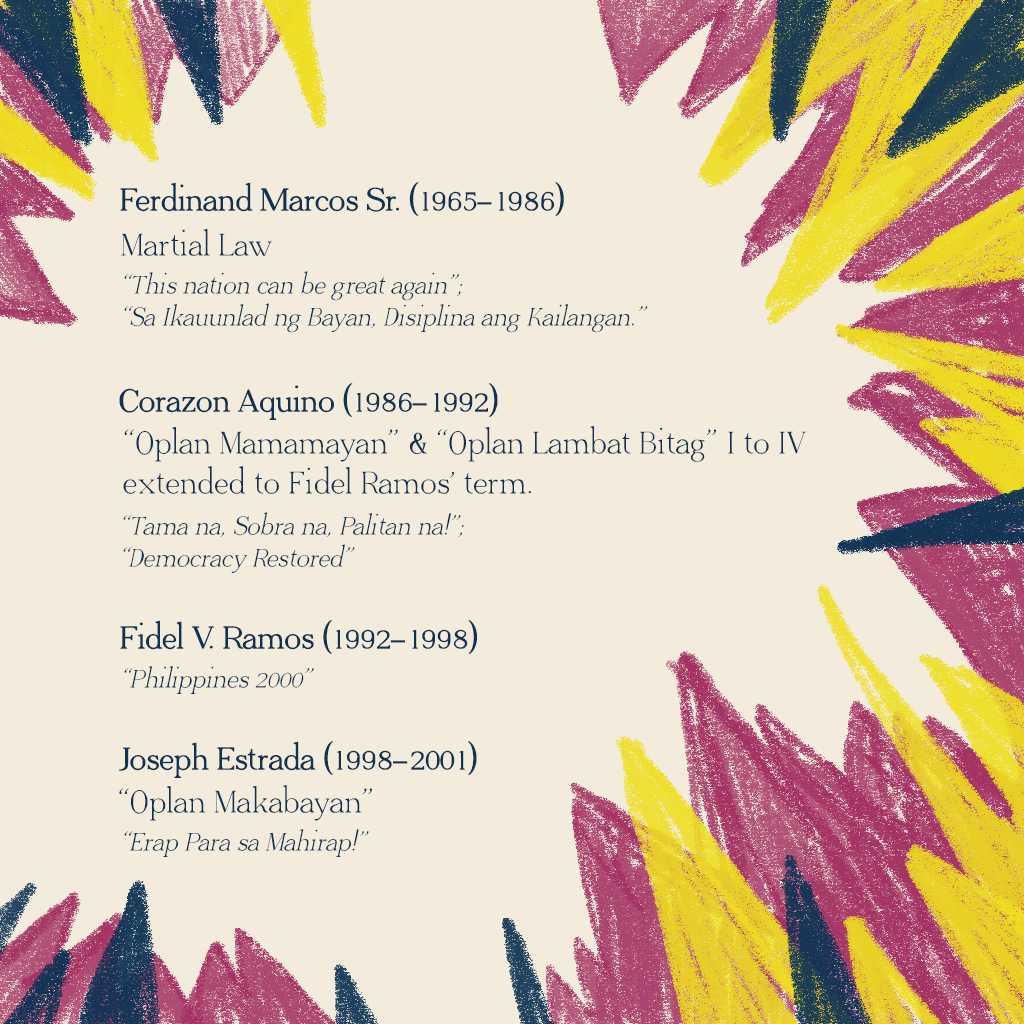
5. Deceit and mind conditioning are features of fascism, thus catchy slogans and tricks are used to gain the support of its followers and rally them against common “enemies”—the subversives, the “terrorists.” They fan anti-communism hysteria by imploring “Filipino pride” and “discipline.” Today’s red tagging/terror tagging is a consequence of this “counterinsurgency” program, akin to the McCathyist witch hunt in the 1960s.
- Ferdinand Marcos Sr. (1965–1986) used “This nation can be great again.” to emphasize nationalism and development, “Sa Ikauunlad ng Bayan, Disiplina ang Kailangan.” (“For the Nation’s Progress, Discipline is Needed.”) used during Martial Law to justify authoritarian rule and “New Society” / “Bagong Lipunan” supposedly promoted “order and reform.”
- Corazon Aquino (1986–1992) “Tama na, Sobra na, Palitan na!” (“Enough is enough, time for change!”) was used during the People Power Revolution and “Democracy Restored” (as a recurring theme during her rule.
- Fidel V. Ramos (1992–1998) had “Philippines 2000” for his regime’s vision for national development and modernization by the year 2000 which turned out to be the full push for imperialist-imposed neoliberal policies such as deregulation, liberalization and privatization.
- Joseph Estrada (1998–2001) “Erap Para sa Mahirap” (“Erap for the Poor”) glorified his so-called populist and pro-poor agenda.
- Gloria Macapagal Arroyo (2001–2010 came out with “Strong Republic” to give the illusion of political stability and economic reform.
- Benigno “Noynoy” Aquino III (2010–2016) “Daang Matuwid” (“Straight Path”) supposedly for his anti-corruption and good governance platform which was actually riddled with pork barrel scandal.
- Rodrigo Duterte (2016–2022) “Change is Coming” a campaign slogan that deviously promised radical change “Tapang at Malasakit” (“Courage and Compassion”) to highlight his purported leadership style and concern for the common people—the victims of his “war vs. drugs” and “counterinsurgency” program.
- Ferdinand “Bongbong” Marcos Jr. (2022–present) “Unity” / “Uniteam” with Sara Duterte was his be-all, end-all response to the country’s dire situation. “Bangon Bayan Muli” (“Rise Again, Nation”) was coined for a post-pandemic recovery and revival message, then into “Bagong Pilipinas,” echoing Marcos Sr’s “Bagong Lipunan” in the 70s but re-branded for “modern” governance.
6. Related to the use of deceit and mind conditioning is the building up of a cult personality. Following his self-proclaimed idol Marcos Sr, Duterte centered around a strongman image: anti-elite, anti-crime, authoritarian as he glorified violence and dismissed legal norms. History is revised and rewritten based on a narrative to change the facts and make bad leaders look good and suit their interests e.g., the Marcos family did not steal, Duterte did not kill. Gloria Arroyo also tried to prop up this image—her “strong republic” branding, siding with the US’ “war vs terror,” launching the bloody Oplan Bantay Laya 1 and 2.
The Marcos family’s return to power involves a strategic revision of historical facts, softening the legacy of martial law and dictatorship. This is what the Duterte’s are doing as they try to clean up the crimes they committed while in power. Fascist regimes often do this to hide their crimes and stay popular.
It’s in the system
The police brutality we witnessed are part of a system that has remained unchanged throughout the decades, from Marcos Sr and Marcos Jr. Through dictatorship—open or undeclared—the reactionary state uses force and terror against people and movements to protect and create stability in the semicolonial and semifeudal system that benefit the ruling classes.
Throughout our history, fascism has presented itself in varying forms and degrees. Violence played a central role in suppressing all forms of collective resistance from the people—from the legal democratic mass movement to the armed revolutionary struggle of the people—where all state apparatus systematically and ideologically act to suppress dissent and strip people of the civil liberties and democratic rights and criminalize the act to create a humane society.
“Pasismo ng estado, dudurugin!” (Smash fascism) has been a call even before the formal declaration of martial law in 1972. It comes alongside the call to “Ibagsak ang imperyalismo, Ibagsak ang pyudalismo, Ibagsak ang burukrata kapitalismo” (Down with imperialism, feudalism, and bureucrat capitalism)—the three basic ills of that define the semicolonial and semifeudal character of Philippine society, a decaying system from which fascism emerges.
Without overthrowing the semicolonial and semifeudal system through the national democratic revolution fascism prevails. ### (Iliya Makalipay)