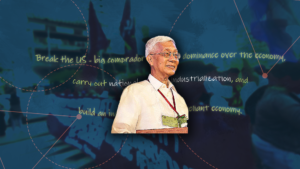
To his very last breath, Prof. Jose Maria Sison never faltered in the belief that the national democratic revolution will be victorious. It is invincible, he said.
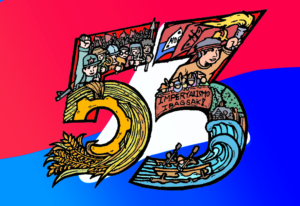
Three years since his death, the revolutionary movement he founded 57 years ago continues to advance with the support of the masses in the countryside and in the cities as it pursues the rectification movement and takes stock of the lessons from the past, learns from the teachings of Marx, Lenin, and Mao and from the wealth of his writings on Philippine society and revolution, anti-revisionism, and the socialist future.
As the rectification movement enters its third year, the Central Committee of the CPP said, in its 57th anniversary statement on December 26, 2025, that the Party has achieved “meaningful advances in the ideological, political, and organizational fields.” Recognizing the contributions of all members and cadres, especially the young cadres the CC announced: the “Party is now well-positioned to lead the broad masses of the people in all fields of struggle, primarily in the field of armed struggle.”
Waging armed struggle, overcoming relentless fascist attacks
Led by Marcos Jr, the reactionary regime and its armed forces gloat on the so-called defeat of the revolutionary movement, of the New People’s Army. But that’s just it—finding pleasure and self-satisfaction over imagined reality.
It is no different from the case of the revolutionary movement in Mindoro, which has for many times been declared by several regimes as “insurgency free.” But in 2025, the New People’s Army bravely and actively fought the combined forces of the Armed Forces of the Philippines, Philippine National Police and the Citizen Armed Force Geographical Unit. The Lucio de Guzman Command of the NPA in the island had 16 firefights, resulting in heavy casualties among the enemy forces while minimizing casualties among the Red fighters despite the AFP’s use of artillery and heavy weapons.
The same is true with the NPA-Apolinario Gatmaitan Command of the Negros Island Regional Operational Command which forges ahead to full recovery and advance as it implements the rectification movement. Like Mindoro, several commanders of the AFP battalions in Negros hailed their “success” in dismantling the guerrilla fronts in Negros Island. But many have left their positions a failure.
Amid intensified military operations, the Roselyn Jean Pelle Command launched counter-encirclement with more than 20 offensive operations and seized high-powered rifles and ammunition. It has expanded its area of operations and recorded a 12 percent increase in the number of fulltime Red fighters and almost 20 percent in the number of people’s militia. The NPA fighters have consolidated through political education and military training.
Strengthening the mass base
Recovery, expansion
Among the things the masses appreciate with the revolutionary movement is its ability to critically examine its strengths and weaknesses and rectify errors. The rectification movement is an occasion to openly discuss these critical self-examination with the masses; and, a time for the masses to hold criticism and self-criticism sessions with the revolutionary forces.
Among the things the masses appreciate with
the revolutionary movement is its ability to
critically examine its strengths and weaknesses and rectify errors.
This kind of relationship helps deepen the roots of the CPP and the NPA among the masses. Accordingly, this sustains the work of the revolutionary movement among the masses—both in good and bad times.
On December 26, 2025, the Party, the NPA and the masses in Mindoro proudly raised the Party’s flag in a gathering to celebrate the 57th anniversary of the CPP. It proclaimed, through Ka Madaay Gasic, spokesperson of NPA-Mindoro, that it has “reached and reactivated 84% of the towns on the island and a significant number of villages through the spirit of rectification and guidance of the Party.”
Part of reaching out and reactivation of the mass base were the establishment of revolutionary mass organizations, holding of medical missions, political education, and training e.g., self defense. Some NPA units also joined the masses’ food production work and facilitated problem solving sessions on the day-to-day concerns and problems of the masses.
In Masbate, Party members and Red fighters revisited the villages they had not seen in years as part of the rectification movement. Despite the long absence, the people were still welcoming, embracing them wholeheartedly because they recognize the Party and the NPA’s track record in helping them regain their land and other democratic rights.
The masses in a village in Rizal province responded in the same way when an NPA unit went back to their village and explained the rectification movement, held study sessions, and helped in the production work. While they did not allow the Red fighters to sleep in their village as the military moved past their houses unexpectedly, the masses looked for ways to provide food for the NPA unit.
Consolidation towards revolutionary mass organizations
NPA units operating in a guerrilla front in Negros Occidental revived revolutionary mass organizations in a village despite intense military operations, surveillance, threats. The masses in this barangay have long endured military abuses and crimes, aside from feudal and semifeudal exploitation by landlords.
The more than 2,000 individuals mobilized in a mass meeting were later organized as chapters of the Pambansang Katipunan ng mga Magbubukid (PKM), Makabayang Kilusan ng Bagong Kababaihan (Makibaka), and Kabataang Makabayan (KM). An almost platoon-size local militia, a defense unit in every sitio, and the village Party branch were also established. Only three kilometers away from them, there were military troops operating.
This was made possible by the dedicated effort put into the preparation—series of consultations among the Party collectives, NPA units and key leaders in the village, careful and comprehensive planning including monitoring of the enemy’s movements, discussing with the masses the summing-up documents and a review of the CPP’s revolutionary guide to agrarian reform. The courage and the revolutionary zeal shown by the masses in this barangay dates back to the 1960s, which they have consistently upheld up to the present—a rich revolutionary history.
In urban centers
Heeding the Party’s call for exposures and integration and deployment in the countryside and guerrilla fronts, the youth and professionals from the cities offered their expertise while acquiring practical experience in the work of the Red fighters—waging armed struggle, building and strengthening the mass base, and agrarian revolution. Simultaneously, these endeavors activated and energized their organizations, driving forward the underground revolutionary movement in the cities and boldly advancing the call to join the NPA.
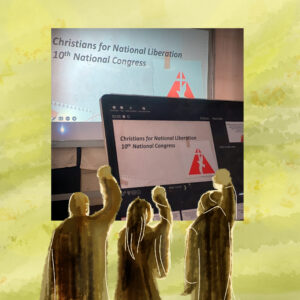
Chapters of Kabataang Makabayan and Makabayang Samahang Pangkalusugan (MSP), held assemblies as part of their consolidation process. The Katipunan ng Gurong Makabayan (Kaguma) likewise successfully held its 4th National Congress after 24 years. The Compatriots-Christians for National Liberation had its global launch in the United States in October 2025.
Since the start of the rectification movement, revolutionary organizations allied with the National Democratic Front of the Philippines (NDFP) have become more visible in urban centers, including in Metro Manila. They have been holding lightning rallies, cultural assemblies, education sessions, Operation Dikit-Pinta, balatengga or streamer hanging, sticker bombing. With the guidance of seasoned cadres, the majority of participants who are newcomers have successfully conquered their initial fear and hesitation.
the challenge at this point is for the members, cadres, activists, and the mass base to
embrace the growing and evolving responsibilities and sacrifices with steadfast determination,
believing wholeheartedly in the
Party’s vision and path to victory
The issuance of statements and the revival and regularization of publications in the regional and national levels of the revolutionary mass organizations and other propaganda work have become significant in battling the reactionary government’s terrorist tagging and more importantly, the claim that there are no more guerrilla fronts in the country.
Through rallies and diverse forms of propaganda, they have bolstered the urgent call to unite and join the people’s army in pursuit of the national democratic revolution.
The Party recognized all these efforts in its December 26, statement: “They bring together and consolidate the advanced sections of the masses taking part in mass struggles. They serve as the underground backbone of the broad, open mass movement, guiding the masses to avoid reformism in waging their struggles. In urban areas, the call for enlistment, especially from among the petty-bourgeois intellectuals, to go to the countryside for temporary or long-term deployment is growing stronger. Their contributions to invigorating educational, cultural, and other aspects of work in the people’s army are invaluable.”
Deepening ideological foundation, strengthening unity
Launched in 2023, the rectification movement is primarily a study movement on Marxism-Leninism-Maoism and the Party’s basic principles aimed at repudiating “primarily, empiricism and, secondarily, dogmatism in ideology; to eliminate conservatism, liberalism, tailism, and sectoralism in politics; and to eliminate bureaucratism and ultra-democracy in organization.”
Education sessions and political studies are regularly held; and various learning aids are employed to facilitate and deepen the discussions.
The revolutionary movement in Agusan-Surigao provinces held, in batches, vigorous study sessions on regular Party courses as well as basic activist courses. These were enriched by the sharing of experiences both in mass work and in waging armed struggle, especially by seasoned cadres. The Southern Tagalog region takes pride in the 5,000 members based in both urban and the countryside who finished the basic Party courses.
In a guerrilla front in Samar, a weekly political education day for the Red fighters was designated. This consists of discussion of a statement, or news heard over radio, watching political and war films, including videos of mobilizations in urban centers. The videos of mobilizations in the cities is a way of connecting the struggles of those in the countryside and to show that even those in the cities do struggle and protests. “Of course, we adjust when there are military operations. But the military can not be in all places at the same time, so there’s really space for these kinds of activities,” said the Region’s propaganda officer.
Many references, documents, courses, and reading materials have been translated in local languages as in the case of Negros Regional committee, which ensured that there are Hiligaynon translation of various materials needed for education sessions, especially among the basic masses. Other regions produce localized primers. In Southern Tagalog, they produced and used a primer to unite the masses on the revolutionary history and significance of their town, its current situation and classes within. These discussions facilitate the establishment of groups and branches of revolutionary mass organizations in the locality.
Outside the formal sessions and when situation allows, discussions over coffee or meals continue to be a learning session among the seasoned cadres and the young members, those from the countryside and the cities, of the Party and the NPA—which provide lessons, inspiration, and vigor that would fuel the revolutionary to greater heights in the coming years.
As a study movement, the third kilwas does not only consist of studies and discussions but also, and equally important, is the summing-up of years of practice and engaging in a thorough investigation of the current social realities and updating class analysis from local to the national level.
Members and cadres of the Party, the Red fighters and the revolutionary mass base easily united on the need for the rectification movement. As the North-Eastern Mindanao Party and NPA units said, “the comrades are excited and enthusiastic to face the challenges, having achieved the goal of starting the rectification movement, consolidating, identifying every detail of their shortcomings and errors, and overcoming weaknesses with determination to make even more progress in the future.”
The Negros Island Regional Committee meanwhile has “accumulated golden lessons as solid basis for formulating the overall plan and direction that will further strengthen the foundation of our Party” after the summing up of their revolutionary practice. The Party even reviewed their assessment reports of 22 years, starting from the mid-1990s.
Conferences and training like those held in Southern Luzon were also employed to focus on certain lines of work such as mass work, military work, health, etc. Case studies were presented in these conferences e.g. methods in mass work and concerns on expansion, consolidation, the importance of participation in production work of the masses, conservatism, and many others. In military work, case studies of successful and failed tactical offensives, defensive battles were also discussed.
Celebrating victories
While celebrating the victories achieved through the rectification movement, the Party acknowledges that numerous challenges and significant effort still lie ahead as we strive to advance further. It stressed, “some areas have lagged behind and some have suffered losses due to still unrectified weaknesses and in the face of relentless attacks of the enemy.”
The Philippine crises will always breed revolutionaries as NDFP’s Secretary General Elias Dipasupil said in a statement in July 2025. But as the revolutionary movement strengthens itself ideologically, politically and organizationally, through the rectification process, individual members should also “steel their fighting spirit, deepen their understanding of Philippine society, get closer to the basic masses, expand and consolidate their organizations, be good at united front tactics, and march forth.”
As the revolutionary movement continues to implement the rectification movement, the challenge at this point is for the members, cadres, activists, and the mass base to embrace the growing and evolving responsibilities and sacrifices with steadfast determination, believing wholeheartedly in the Party’s vision and path to victory. ### (by Iliya Makalipay, culled from news reports of Ang Bayan and articles from Liberation).