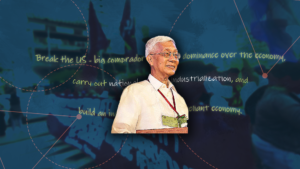
More than six decades of uniting the people by studying and analyzing Philippine society, establishing and leading revolutionary organizations, and launching one of the world’s longest people’s war for national democracy, no one embodies the National Democratic Front of the Philippines’ (NDFP) first aim in its 12-point program more than Jose Maria Sison.
Joma united the people by first immersing himself in the study and analyses of Philippine society and concluding that a national democratic people’s war is the only way to overthrow the country’s semicolonial and semifeudal system. He founded Kabataang Makabayan (Patriotic Youth) in 1964 before founding the Communist Party of the Philippines (CPP) in 1968. In 1969, he established the New People’s Army (NPA) and in 1973, led the establishment of the NDFP.
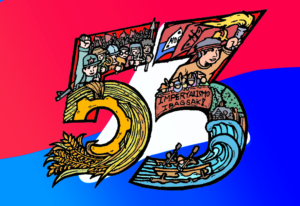
In its 55-year revolution, no other political force has united the Filipino people, including the Moro and indigenous peoples, as much as the CPP, its people’s army and united front to defeat the oppressive semicolonial and semifeudal system to establish a national democratic government with a socialist future. All of these have been inspired and led by Joma. From his youth to his very last breath, he had served as a uniting factor and inspiration with his intellectual brilliance and revolutionary fervor. He has no equal in personifying NDFP’s rallying call to revolution.
Youthful awakening
In a 2023 NDFP-produced biopic, Joma himself revealed that even as a child, he already realized the poverty of the Filipino masses, particularly the peasants. He found their destitution incongruous with the rose-colored promises he heard from politicians in his home region of Ilocandia. Many of those politicians were relatives, leading his father to advise him to become a lawyer and then become a politician himself. Joma said he initially agreed to the plan, but only to help the poor through free legal services.
It was a track expected of the obviously bright boy whose prominent landowning family included a paternal great grandfather who was the biggest landlord in all of northern Luzon at the end of the 19th century. His grandfather was even the last gobernadorcillo (mayor) of Cabugao, Ilocos Norte under Spanish colonial rule. Other forebears included governors of Ilocos Sur and Pangasinan, even a defense secretary in the US colonial regime. Joma’s mother was herself a daughter of landowning families in Pampanga from which he first learned about the Hukbong Bayan Laban sa mga Hapon (HUKBALAHAP) and the first Communist guerrilla movement in the Philippines.
But by his college senior year in 1959 at the University of the Philippines in Diliman, the plan was abandoned. Joma was about to graduate with a Bachelor of Arts in English Literature degree with honors when he co-founded the Student Cultural Association of the University of the Philippines (SCAUP). This was in protest against the 1957 Anti-Subversion Law that was used for conducting an anti-communist witchhunt in collaboration with the US Central Intelligence Agency and the clerico-fascist elements in the dominant Catholic Church. “We openly announced the objective to study and learn from the revolutionary history of the of the Filipino people against Spanish colonialism and then against US imperialism and to strive to continue the unfinished national democratic revolution, no longer under the leadership of the liberal bourgeoisie but under that of the proletariat,” Joma said about those heady days.
At the same time, Joma and his equally young comrades secretly conducted study meetings on the theory and practice of Marxism-Leninism in relation to Philippine history and current circumstances of the Filipino people.
It was at this time when his dream of becoming a lawyer was gradually weakening and diminishing, Joma said. “By 1959, I realized it was really silly and that waging revolution was what was really needed,” he laughingly recalled.
Joining the old Communist Party
Joma studied for a time in Indonesia and returned to become a literature, Rizal Studies and political science professor. In December 1962, he joined the Lavaite Partido Komunista ng Pilipinas (PKP) and immediately became a member of its executive committee. As vice-chairperson of the Lapiang Manggagawa (Workers’ Party) in 1963, he led its consolidation in 1964 and reconstitution as the Socialist Party in 1965.
“I joined the Lapiang Manggagawa for political education work among the trade union members in the latter half of 1962. I became the head of the research and education department of the Party. I was in charge of research, drafting party statements, issuing publications and holding seminars. The student activists from various universities joined the workers in seminars. Later on, children of veteran peasant leaders from the rural regions close to Manila also joined,” he told the progressive website Descifrando La Guerra.
In 1964, he co-founded the Kabataang Makabayan (Patriotic Youth) that organized the Filipino youth against the imperialist war in Vietnam, the emerging Ferdinand Marcos Sr. dictatorship, imperialism, bureaucrat capitalism and feudalism.
Soon enough, all the organizations Joma was leading were able to launch mass actions on national issues against the reactionary government and its pro-imperialist policies, especially economic and military subservience to the US. “My experience in organizing and arousing among the students was immensely useful. This experience I developed I would later bring to the ranks of the workers,” Joma said.
Ever-observant and always unafraid to challenge wrong ideas and grievous mistakes, Joma studied and investigated the errors the series of Lava siblings committed in essentially liquidating the old Communist Party. He learned that there had been no single Party collective organ or any Party branch in existence for some year. Then secretary general Jesus Lava was merely hiding himself in Manila without connection to any mass base or armed force since 1957 when he issued policies that made the Party moribund. Within the Executive Committee, Joma learned from internal documents and from his conversations with veteran worker and peasant cadres the facts about the errors that plunged the organization into liquidation. When his draft of the document titled “Rectify Errors and Rebuild the Party” was rejected by the pro-Lava majority of the Executive Committee, he left.
Founding, leading the Communist Party of the Philippines
Convinced that only through the implementation of the recommendations of the document in a Great Rectification Movement would save the Communist movement in the Philippines, Joma led the formation of CPP on December 26, 1968. The new Party, guided by the universal theory of Marxism-Leninism, is tasked to apply it on the concrete conditions of the Philippines and to integrate it with the concrete practice of the Philippine revolution.
In his trademark fashion, Joma lost no time in establishing contacts with remnants of the Hukbalahap to establish the New People’s Army on March 29, 1969. The NPA is the CPP’s principal organization in consolidating political power in the overthrow of the semicolonial, semifeudal Philippine society to a national democratic revolution.
The movement’s first great victories were the First Quarter Storm of 1970 and the Diliman Commune of 1971, student and worker-led uprisings in Metro Manila. While these uprisings were shaking up the capital, Joma led the preparatory committee for the establishment of the National Democratic Front of the Philippines in 1971. This alliance of revolutionary organizations, currently numbering 18 formations, was eventually established in April 1973.
In 1977, Joma was captured by the fascist military of the dictatorship, but the revolution he started and inspired could no longer be stopped. “I am happy and proud to say that when I was captured, the ideological, political and organizational foundation of the revolutionary movement had become solid and strong. The Marxist-Leninist ideological and political line was well-established by basic, intermediate and advanced courses of study among CPP cadres and members, by the rectification movement against the Lavaite errors from 1942 onwards and by the analysis of Philippine history and society by the CPP Program for a People’s Democratic Revolution,” he said.
From a little over 100 CPP members in 1969, they were already in the thousands in 1977, nationwide in scale and deeply rooted among the workers and peasants. From only nine automatic rifles at the start in 1969, the NPA had increased them to more than 2000 automatic rifles in 1977. From only tens of thousands of mass activists in 1968, they were already in the hundreds of thousands in various types of mass organizations in 1977. The rural mass base had been 80,000 in only one district in Tarlac in 1969. There was a total of two million people as mass base in some 40 guerrilla fronts in 1977. They were also under the governance of the local organs of political power or the people’s democratic government, Joma narrated.
Regaining freedom in 1986 after the ouster of the dictator Marcos, Joma was forced to apply for a political asylum status in The Netherlands after the Corazon Aquino regime canceled his Manila government-issued passport. In exile, he wrote the document “Reaffirm Basic Principles and Rectify Errors” and led the CPP to its Second Great Rectification Movement against the major errors of subjectivism and opportunism in various regions at various times from 1981 to 1991.
Joma died in December 16, 2022 in Utrecht, The Netherlands. He was 83. But nearly 56 years since founding and leading the CPP, the Party and the NPA have carried out the people’s democratic revolution in preparation for the subsequent stage of socialist revolution. It has stood out as the advanced detachment of the Filipino proletariat and as the leading force in the Filipino people’s democratic revolution. It has firmly upheld its revolutionary principles and won brilliant victories in revolutionary struggles against all forces that oppress and exploit the Filipino people. ### (Leon Castro)