(The details of Binukot Elma “Dalama” Villaron’s story were culled mainly from the documentation of UP-Mindanao professor M.A. Bañez published in the 1990s as told by Luisa Posa Dominado. Both Dalama and Dominado were red fighters of the New People’s Army during Martial Law—Ed).
Many stories have been told about Elma “Dalama” Villaron as a binukot turned revolutionary warrior. But it is through the eyes of a fellow red fighter, a Marxist thinker, and a trusted friend, Luisa “Luing” Posa Dominado, that her transformation is fully understood. This story didn’t even end with the binukot’s death as the storyteller herself has a remarkable revolutionary journey. Several decades later, Luing, as her friends and comrades call her, will become a victim of the state’s enforced disappearance.
It was Dalama’s father Mal-am Sardin, who decided that she would become a binukot. In Panay Tumandok tradition, the fairest daughter is chosen to be the family’s binukot—secluded from early childhood, exempted from manual labor, and hidden from the outside world. She is taught embroidery and chanting the sugidanon—a form of oral literature—and becomes a vessel of the community’s memory. Dalama was one such vessel, kept apart, her role is to preserve tradition, to sit still, and to embody grace.
Keeping a binukot was a status symbol of a family’s relative affluence, since it meant not only keeping an otherwise useful hand away from the fields but additional hands removed from production to take care of the binukot’s requirements for her upkeep such as fetching water for her bath and assisting her basic necessities.
Thus, she would command a higher bride price because any family who sought her hand in marriage had to prove they had the means to maintain her status. Having a binukot wife itself also spoke of affluence for the family involved.
But the world outside is not still.
Binukot as a dying tradition
According to Luing, more than anything else, it was the intensifying economic crisis of the 1960s that pushed the tradition of keeping a binukot among the Tumandok to the brink of extinction. It became impractical for families to maintain a binukot when they no longer had surplus harvests from the kaingin and poverty required every hand available for production to pitch in.
For Dalama, it was compounded by her father’s imprisonment after he led a clan war, panambi, against the Akeanon (indigenous people of Aklan who shared a common mountain boundary). With fewer hands to work in their kaingin, Dalama’s family accepted her decision to cease to be a binukot. She was 15 years old then.
Two women warriors meet
Luing recounted that at the age of 17, in 1971, Dalama attended a school set up by the New People’s Army near their residence in Aglupacan, Tapaz, Capiz. There, she learned basic math, reading, and writing. Alongside these skills, socio-political issues were also discussed in the school—planting the seeds of her political awakening.
The next year, 1972, dictator Ferdinand E. Marcos Sr declared martial law. Luing was among the many activists who went underground. Meanwhile, Dalama during this time was already helping the NPA unit in their community. In 1977, Luing and Dalama met, both as NPA members. They were assigned to the same unit, four of them women—Luing the only lowlander. Luing and Dalama were then both 22 years old.
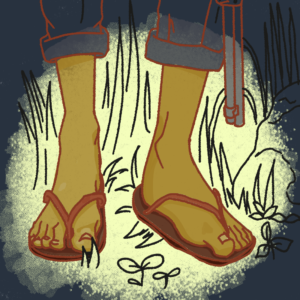
Luing saw Dalama’s compassion for people, even to those different from her. At that time, women in the NPA were assigned to camp duty. But they insisted they be allowed to join their male comrades in the mobile units. In keeping with the NPA’s methods of work to merge their lives with the masses, they refrained from wearing slippers because the indigenous people walked barefoot. Luing, coming from the city, complained that her soles hurt from the sharp stones and thorns along the trails. She insisted on wearing slippers. Her two companions would discourage her but Dalama would explain to them that Luing’s soles did not have the same thick calluses as theirs and that they should show more compassion.
But it was not only compassion that made her a “fearless red fighter”, a common description among her male comrades. She was also good in military work and would become Ka Randa, one of the few women commanders to lead an NPA unit. She became skilled in conducting tactical offensives. As CO, she carried a browning automatic rifle (BAR)—commonly issued to male fighters because of its weight of 30 kilos—earning her moniker BAR woman.
Dalama’s openness also led her to improve her writing and reading comprehension skills, which Luing helped her with. Luing described Dalama as a diligent and enthusiastic student. Dalama tirelessly copied the whole Mao’s Red Book into her notebook to practice her writing. Dalama would later become an instructor of Party courses, and led Marxist-Leninist-Maoist educational discussions. Luing recalled their good tandem in teaching dialectical materialism. Luing would provide the theoretical discussion while Dalama would elaborate the theory by using illustrative examples. Explaining the concept of universality and particularity, Dalama would use the analogy of the Pan-ay River and its tributaries.
Carrying out the Party’s line in organizing among the tribes, Dalama negotiated peace agreements between communities of Pan-ayanon and Akeanon to end the long history of clan wars. She convinced them to unite against a common, bigger enemy— the three-headed monster of feudalism, bureaucrat capitalism, and imperialism.
It was the time when the anti-feudal campaign succeeded in raising the wage of agricultural workers who took on work as seasonal harvesters. From 1/10 of the coffee bean harvest and 1/8 of rice grains harvested, the organized peasants, with the help of the NPA of Panay, were able to raise their harvest shares to 1/8 of coffee produce and 1/6 of palay (unhusked rice grains).
With revolutionary determination to learn more and to share the experiences she had gained with more revolutionary forces, Dalama bravely accepted the task of leading an NPA unit to a newly opened guerrilla front at the other side of the province, far from her family and home, with a culture totally different from hers and no indigenous people aside from her.
Mother-warrior
Dalama suffered from the dilemma of motherhood—that of often longing to be with her children while living fulltime in the guerrilla front. But, with the movement’s increasing success in recruitment and in accumulating firearms and ammunition, the morale of the comrades were high, and these helped ease her motherly longing.
But Dalama would often tell Luing of her problems with her husband, children, and in-laws. She wanted to spend more time with her children but could not get them from her urban-based middle-class in-laws. Aside from being poor, her family came from the most remote areas of the mountains that even indigenous people from the lower reaches of the mountains could not easily access. The in-laws also disapproved of the children visiting her in the countryside worrying about their safety. They suggested she choose between being with her children and giving up the armed revolution. Of course, it was clear what path she chose.
Her relationship with husband Baran was not also easy because of differences in their upbringing and culture. Luing had to mediate between the two whenever they had problems. Luing said Dalama complained that Baran would readily accept an explanation if it came from her, even if it is same idea that Dalama was communicating.
In the face of the enemy
Dalama was only 32 when she was killed in a firefight in Maayon, Capiz. It was in 1987, a time when the NPA had started its wrong line of military adventurism—and guerrilla fighter were overstretched from one tactical offensive to the next—resulting in many casualties in military offensives.
“If Dalama were alive today, she would have made a significant contribution to the Second Rectification movement,” was Luing’s closing narrative.
If Dalama was the BAR woman, Luing was Kumander Pusa. She earned the moniker for her ability to slip out of prison. At 17 years old, she was arrested with a group of student activists in Capiz, six months after Martial Law was declared, only to escape from prison within two days.
Four years later, in 1977, she was captured in a firefight in Hamtic, Antique. And, for the second time, Luing escaped from prison—this time with Tomas Dominado whom she married in prison five months before. After this, she joined Dalama in an NPA unit. Two months later, she was captured, and again joined eight other political detainees in a well-planned escape in 1980.
Martial Law had been officially over when Luing was arrested and imprisoned for the fourth and last time, under the Corazon Aquino Regime. She was released in 1993 after two years of detention. Unable now to go back to the armed struggle due to health complications acquired from her long years in detention, she became a leader of the legal organization Kapatid to advocate for the rights of political prisoners.
On April 12, 2007, under the Arroyo regime, Luing and fellow activist Nilo Arado were abducted by armed men in Oton, Iloilo. Their driver was shot in the neck and left for dead but Luing and Nilo were taken by the armed men and have been missing since. Their disappearance is among the numerous cases of enforced disappearances in the country.
Despite the passage of time, Luing and Dalama’s legacies endure as symbols of women’s unwavering commitment to social justice and the revolution. (Mia Andres) ###