An integral aspect of the national democratic program is national industrialization (NI) in tandem with genuine agrarian reform. NI promises to subvert the current import-dependent, export-oriented framework of the Philippine economy in favor of a society that can stand on its own two feet. This is point number 7 of the 12-point program of the National Democratic Front of the Philippines, and we would be hard-pressed to find a better personification of this point than Engineer Ramon “Monram” Ramirez.
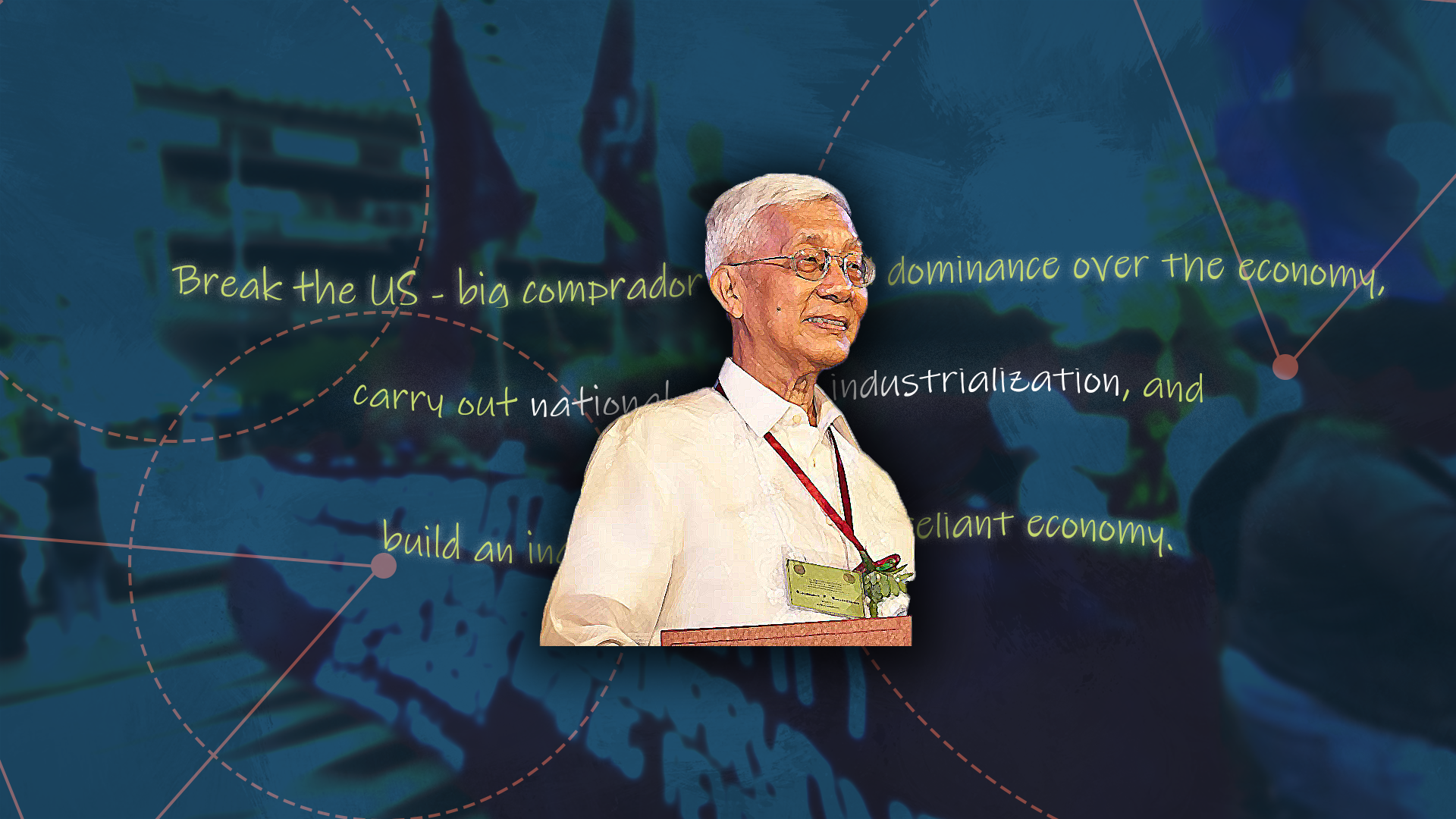
Monram turned his back on a comfortable bourgeois career to serve the Filipino people. In his five decades of service, he brought to life the spirit of national industrialization, specifically in how he helped organize the country’s science and technology sector and move them towards science and technology for the people in the context of the Philippine revolution. In this way, Monram continues to inspire the latest generation of revolutionary scientists, engineers, and professionals.
Powering up the revolution
Monram’s decades-long contribution to the revolution began with his active participation in the Samahan ng Makabayang Siyentipiko (SMS or Alliance of Nationalist Scientists) as an undergraduate electrical engineering student at the University of the Philippines. After topping the electrical engineering boards in 1967, Monram worked briefly for companies such as Coca-Cola and San Miguel Corporation before deciding to leave the corporate world and instead dedicate his life to the revolution.
Monram embodied the “red and expert” character of a revolutionary scientist. In the 70s and 80s, as a staff member of the Central Committee of the Communist Party of the Philippines, he mainly focused on the possible applications of science and technology in military research. Initially based in the cities, Monram’s work eventually brought him and other comrades to the countryside.
Monram brought to life the spirit of
national industrialization, specifically in how he helped organize the country’s
science and technology sector and move them towards science and technology for the people
in the context of the Philippine revolution.
Here, Monram was able to advance revolutionary work by making use of modern technology. One was introducing computer programming into the communication protocols of the NPA. Initially, Monram’s comrades were not too enthusiastic with the new technology. Monram was able to change their minds by programming a device that could answer simple questions related to the revolution—perhaps the first ever AI chatbot used in the countryside! From there, Monram’s computer work expanded, particularly into the field of programming, encryption, and communication.
Aside from tinkering with computers and programming, Monram and his other comrades in military research were also instrumental in other technological advances in the revolution, such as the setting up Radyo Sierra Madre and its guerrilla broadcasts in the mid-80s and the development of a portable acupuncture stimulator.
On top of technical services for the revolution, Monram played a big role in organizing within the science and technology sector. He was one of the founding members of Liga ng Agham para sa Bayan (LAB) and contributed to the publication of Agham Bayan, LAB’s official newsletter.
Catalyst for change
For his active participation in the revolution, Monram was arrested twice by the reactionary government—in 1973, and again in 1992. These incidents did not stifle his perseverance. After his last arrest, he continued to contribute to the national democratic cause mainly as an activist in the legal mass movement.
In 1998, Monram was instrumental in bringing scientists, engineers, and professionals together for a conference on the state of science and technology. The keynote speech of Luis Jalandoni in this conference became the basis for future discussions on the state of Philippine science and technology, through the publication of what many S&T advocates and activists now call the “blue book.”
Monram embodied the “red and expert”
character of a revolutionary scientist.
In the 70s and 80s, as a staff member of
the Central Committee of the
Communist Party of the Philippines,
he mainly focused on the possible applications
of science and technology in military research.
Another one of Monram’s contributions was his involvement as the convenor of People Opposed to Warrantless Electricity Rates (POWER), an alliance which fought for consumer rights in electricity. With POWER, Monram made use of his vast experience with Meralco to score a victory for consumers in its case against the company in 2002. Monram is also well-known as one of the founders of Arkibong Bayan, an initiative which sought to record people’s struggles through documentation and archival work.
Monram’s work as a national democratic activist was in fact recognized by several institutions. In 2011, he was granted an outstanding alumni award for social cohesion by the University of the Philippines Alumni Association. In 2019, he was named by the UP Alumni Engineers Association as a National Achievement Awardee in Public Services.
Passing the torch
Monram passed away on August 28, 2021 at the age of 77, at the height of the COVID-19 pandemic. Up until the very end, he made sure to give what he could to the revolution. He made sure to attend the State of the Nation Address (SONA) mobilization a month before his passing, despite his old age and the public health situation.
Monram’s spirit and dedication lives on in the work of all the comrades whose lives he touched. Emily (not their real name), a younger comrade who was able to work with Monram towards the latter part of his life, remembered fondly how Monram was a pleasure to work with. She shared how Monram would always crack nerdy jokes and keep things light-hearted even when talking about work.
“Monram always struck me as the ‘techie’ of the movement,” shared Emily. “He was always the one pushing comrades to use new technologies like the PDF format, Google, and social media during his time. Nowadays, these seem as the norm but back then they were new things to work with.”
People like Emily and countless scientists, engineers, professionals, and students continue to be inspired by Monram’s life story. Perhaps this is also the clearest way in which Monram captures the spirit of national industrialization—more than just applying his own expertise, he endeavored to inspire so many others to contribute to the cause, so that we may achieve our collective goal of a better future for all Filipinos. ### (Bernadette Rojo)